Concepts
Multi-agent applications don't fail because agents can't reason; they fail because they can't share what they know. An agent needs to remember preferences, use knowledge, and keep its conversation history, efficiently and alongside other agents doing the same.
The usual answer bolts together PostgreSQL, pgvector, a separate memory store, and an object store for conversations. That splits the data into silos, adds cross-system latency, and leaves you writing the tiering and observability yourself. Meko replaces it with one data layer behind one MCP endpoint.
Read these pages in order. Each assumes only the ones before it.
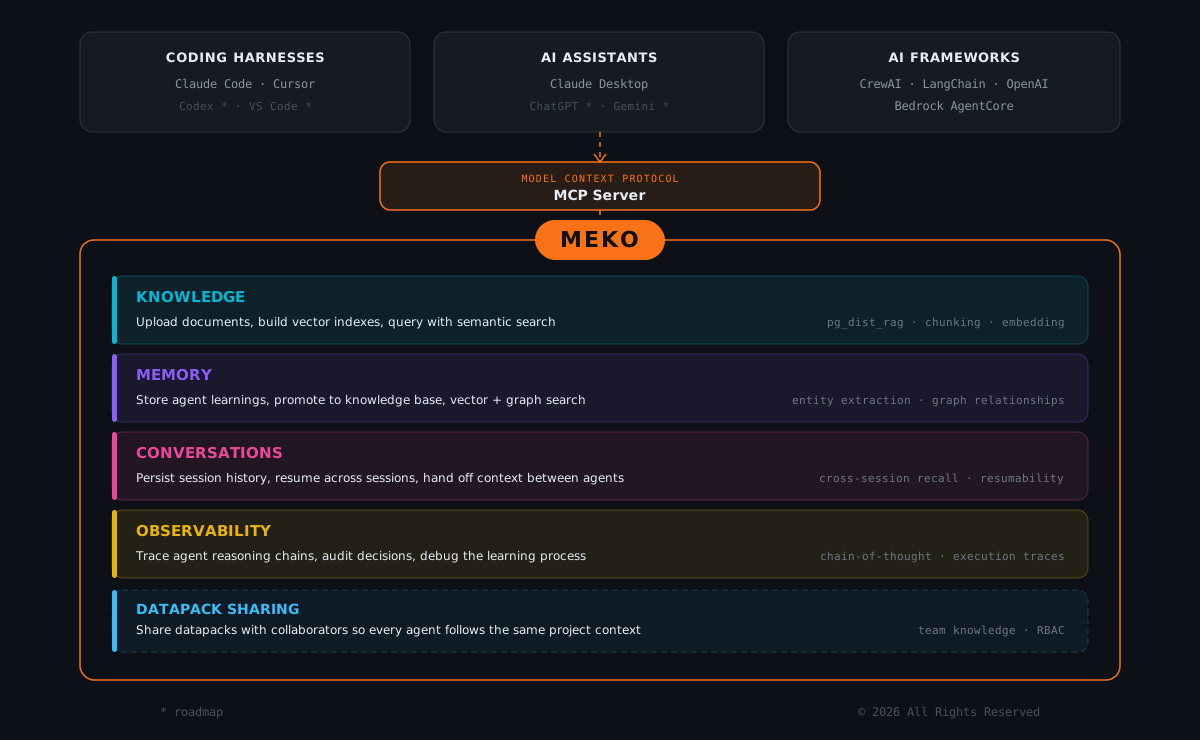
What is Meko
Where Meko sits in your architecture, what it replaces, and how it deploys.
Datapacks
The isolation unit for agents working together. Each datapack bundles a database, the knowledge base, memories, and credentials.
Memory
Durable facts, preferences, and decisions Meko extracts from conversations.
Knowledge bases
Documents chunked, embedded, and indexed for retrieval.
Artifacts
Agent-generated files stored and retrieved whole, across sessions and agents.
Conversations and traces
Every conversation from prompt through chain-of-thought, including the memory and knowledge calls and the queries they ran.
Where to store it
How to choose between memories, knowledge base files, and artifacts.
How Meko learns
How Meko ranks what it retrieves, how private memory becomes knowledge the team shares, and what [searches found](/concepts/how-meko-learns/self-learning/).