Core concepts
Meko organizes agent data around a few key concepts. Understanding these will help you get the most out of the platform.
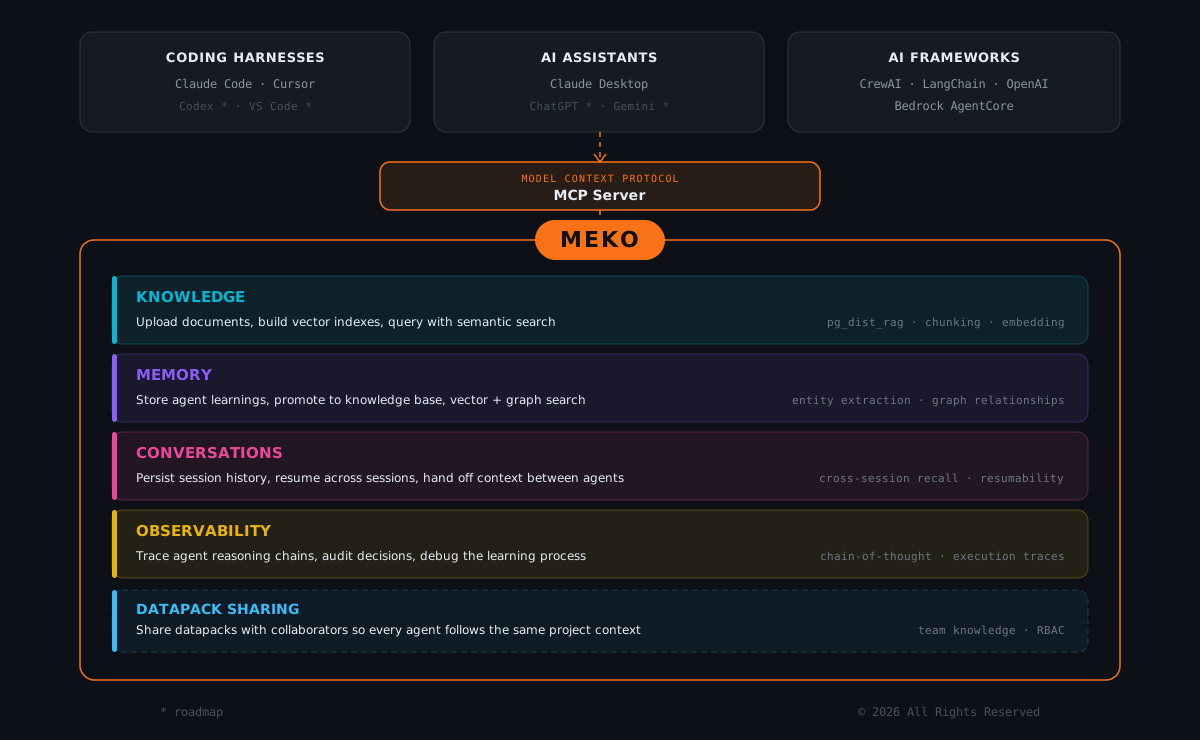
Datapacks
The fundamental storage primitive for multi-agent systems. One datapack per application, or one project. It is the isolation unit for agents working together. Each datapack bundles a database, the knowledge base, agent memories, collective memories, shared knowledge, MCP server, and credentials.
Share a datapack
Share datapacks by inviting people or by sharing a link. In the portal, only the owner manages the link.
Manage datapack access
Manage access to shared datapacks by assigning roles: Viewer, Contributor, or Maintainer.
Projects
Organize related datapacks in a project to work toward a common outcome. Each datapack remains an isolated home for its conversations, memory, and knowledge.
Memory
Meko extracts durable facts, preferences, and decisions from conversations and stores them for long-term recall. Hybrid semantic, keyword, and entity-aware retrieval finds relevant memories across connected agents. Reviewed memories can be promoted into shared datapack knowledge.
Knowledge bases
Information repository that acts as a single source of truth for agents, grounding decisions, reducing hallucinations, and ensuring consistent responses. Uses semantic search and RAG to understand query intent, not just keywords. Documents are chunked, embedded, and indexed for retrieval.
Traces
Meko provides end-to-end visibility into every conversation, from initial prompt through LLM chain-of-thought, including memory and knowledge additions and search, the associated API and SQL calls, the queries executed, and the results retrieved.